Human DNA is often viewed merely as a set of biological instructions responsible for forming and running the body. However, from a broader perspective, it can be understood as a dynamic map of adaptation, learning, and evolution.
DNA as a Map of Evolution
Throughout the history of life on Earth, DNA has allowed organisms to adapt to ever-changing environments. This same principle remains active today: human DNA is not static; it responds to the environment, to experiences, and to each individual's internal state.
Evolution, therefore, is not just a process of the past. It is an ongoing process.
Biological Evolution and Evolution of Consciousness
Modern science recognizes that factors like diet, environment, stress, emotions, and lifestyle influence gene expression through epigenetics.
This opens an important possibility: Internal changes can influence how biological potential manifests.
Some frameworks expand this idea, suggesting human evolution involves not only physical changes but also an expansion of consciousness, perception, and cognitive capacities.
In this perspective, DNA acts as an interface between:
- Biology
- Environment
- Experience
- Consciousness
The Concept of Latent Potential
Much of human DNA does not code for proteins directly. While many of these regions have known regulatory functions, there are still areas whose full purpose is not completely understood. This leads to the idea of latent potential—capabilities that may emerge as internal and external conditions change. The latent potential of DNA can manifest across different levels:
Greater Emotional and Mental Balance
- Better nervous system regulation.
- Greater resilience to stress.
- Mental clarity and emotional stability.
- More frequent states of well-being.
Expansion of Perception and Intuition
- Heightened environmental sensitivity.
- Faster pattern recognition.
- Intuitive decision making.
- Amplified creativity.
Capacity for Regeneration and Health
- Better physical recovery.
- Greater immune efficiency.
- More balanced cellular processes.
- Healthier aging.
Connection with Environment and Others
- Feeling of interconnectedness with nature.
- Increased empathy.
- More harmonious social cooperation.
- More integrated collective consciousness.
Neuroplasticity and Adaptation: Scientific Evidence
Science already shows that the human brain possesses neuroplasticity—the capacity to reorganize neural connections throughout life.
Similarly, epigenetics reveals that:
- Genes can be turned on or off.
- Experiences influence biology.
- The internal environment alters cellular responses.
These mechanisms indicate that human beings have a much greater capacity for adaptation than previously thought.
Accelerated Evolution: The Role of the Internal Environment
A person's internal state can directly influence the quality of their biology. Factors favoring positive expression of potential include:
- Coherent emotions (gratitude, joy, safety)
- Adequate sleep and balanced nutrition
- Physical movement and chronic stress reduction
- Meditative states
- A sense of purpose and meaning
These elements create a physiological environment that fosters balance, regeneration, and adaptation.
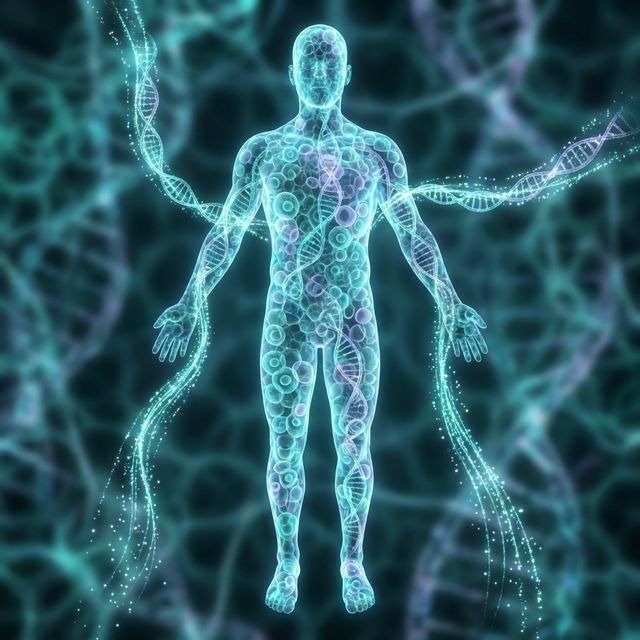
Energetic Perspective on Evolution
Some approaches propose that physical DNA is merely the expression of a deeper energetic template, linked to consciousness.
In this view:
- Human evolution includes the expansion of perception.
- States of consciousness influence biology.
- Human potential has yet to fully manifest.
- Future capacities may emerge naturally along with inner development.
While this perspective remains under scientific exploration, it presents an inspiring model for understanding human growth.
Individual and Collective Evolution
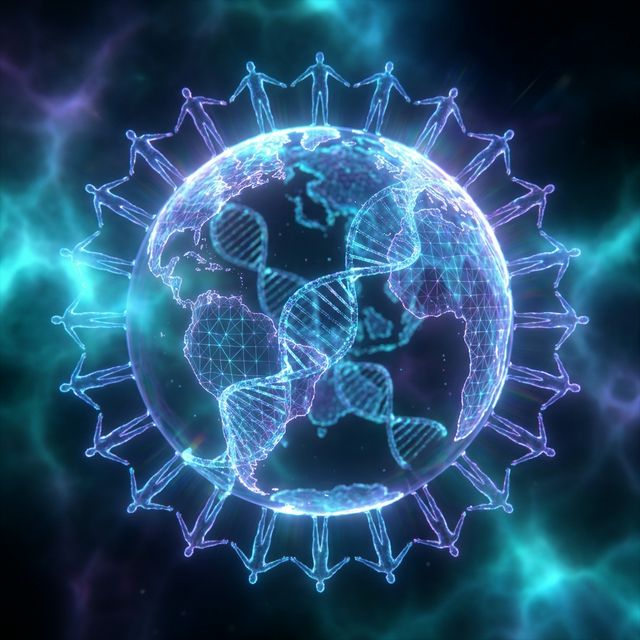
Evolution does not occur just in isolated individuals. Humans live in interconnected social systems.
Changes in individual consciousness can contribute to:
- More cooperative societies
- Greater innovation and sustainability
- Creative solutions to global challenges
- More harmonious relationships
Thus, human evolution can simultaneously be viewed as a biological, psychological, social, and energetic process.
Key Idea
DNA doesn't just define who we are today; it holds possibilities for what we can become.
Exploring this potential involves science, self-knowledge, and experiences that promote internal balance.
Human evolution is ongoing.